
How are the Wafer Brushes produced?
The manufacturing process of wafer brushes begins with a high-end filament fusing machine, which uniformly fuses PP plastic filaments together and places them on a horizontal worktable.
The fused PP plastic filaments are then cut to the required length.
Then the fused PP plastic filament will be placed into another work unit.
There are two types of work units: one consists of a hydraulic press, molds, iron rings, and pins, specifically for producing iron ring brushes; the other consists of a small injection molding machine and molds, specifically for producing plastic ring brushes. Both types are widely used.
Click the Video to Learn More
Our in-house developed machine
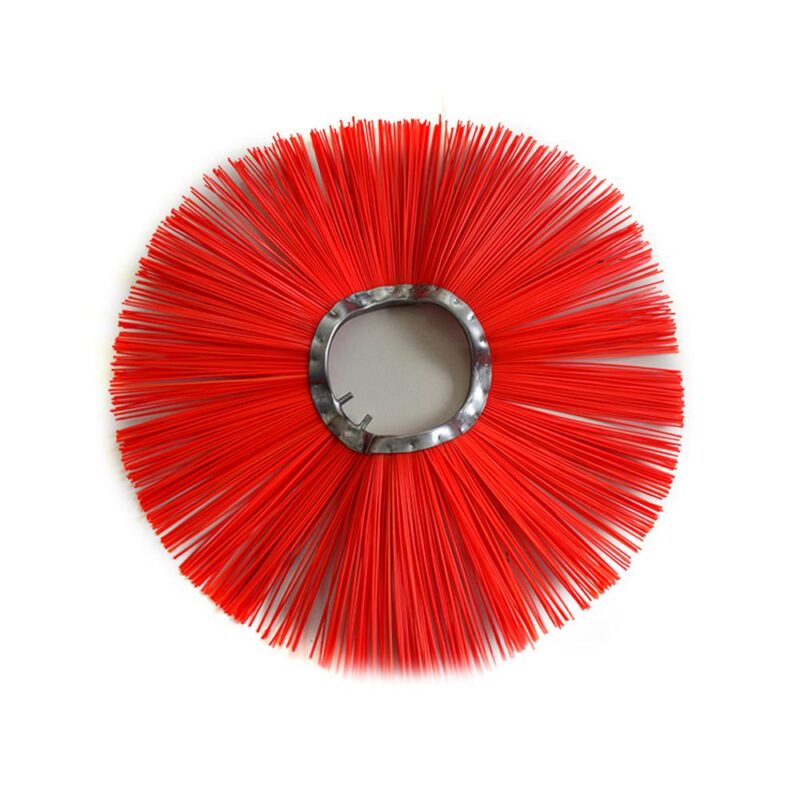
On the metal ring brush
The arc height (including the ring thickness) of the curved metal ring is 45 mm, meaning the height from the ground to the top of the arc is 45 mm.
The thickness of the curved metal ring is 17 – 18 mm, and the thickness of the flat metal ring is 17 mm.
Normally, the curved metal ring requires two pins, and the flat metal ring only requires one pin. However, a very small number of flat brushes on sweepers may require two pins. The pin spacing is generally 30 mm, the pin diameter is 8 mm, and the pin protrusion length is 16 – 17 mm.
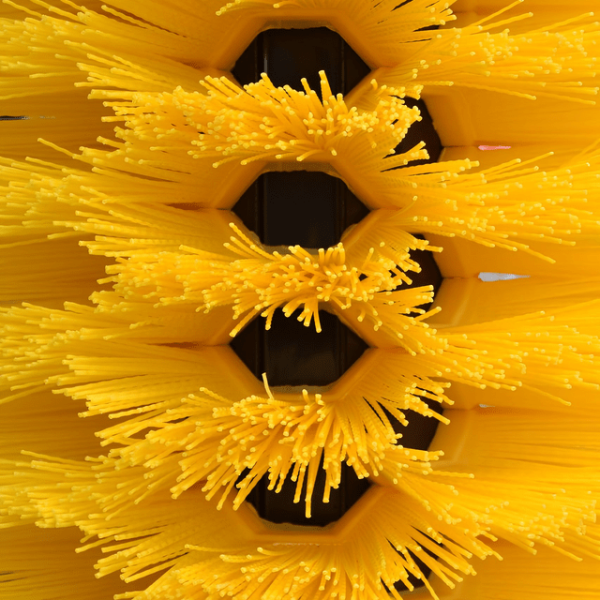
On plastic ring brush
The arc height (including the thickness of the plastic ring) of the curved plastic ring is 45 mm, meaning the height from the ground to the top of the ring’s arc is 45 mm.
The thickness of the curved plastic ring is 14 – 19 mm (varies depending on the size of the brush), and the thickness of the flat plastic ring is 14 – 17 mm (varies depending on the size of the brush).
Normally, both curved and flat plastic ring brushes have two pins, but some small sweepers use flat plastic ring brushes with only one pin.
The pin spacing is generally 20 – 30 mm (varies depending on the size of the brush), the pin protrusion length is 11 – 12 mm (varies depending on the size of the brush), and the pin width is 11 – 13 mm.
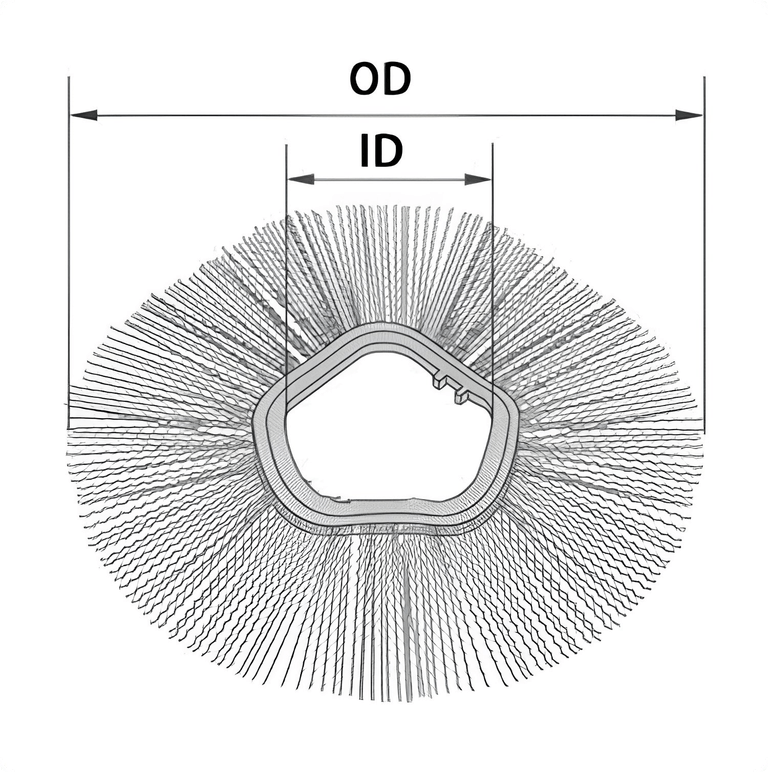
Dimensions of the Wafer Brushes
Include: ID*OD: 128*508 mm, 162*560 mm, 205*660 mm, 222*917 mm, 255*813 mm, 275*913 mm, etc. [Or written as (OD x ID) 18″ x 4.4″, 22″ x 6 3/8″, 24″ x 7″, 26″ x 8″, 32″ x 10″ etc.]
Bobcat 165*610mm, Laymor 162*610mm, CASE 205*660mm, CAT 255*813mm, GF 162*550mm, etc.
The largest wafer brush size we can currently produce is 496 × 1150 mm.
The longest bristles on our wafer brushes can reach 510mm, and the shortest can be 120mm.
These numbers represent the inner diameter (in mm) of the wafer brushes we can produce:
Flat: 66, 78, 100, 110, 120, 128, 130, 162, 165, 169, 177, 180, 185, 205, 222, 240, 255, 260, 275, 280, 300, 320, 495mm
Convoluted/Cambered/Curved/Wavy: 115, 128, 162, 165, 171, 180, 185, 205, 222, 230, 235, 255, 260, 264, 300mm
Angled/Sloped ring: 78, 165, 170, 180, 255mm
These numbers not only represent the inner diameter of the wafers we can produce, but also the significant effort, time, and hundreds of thousands of RMB we’ve invested. These numbers simply express: when it comes to wafer brushes, we are professionals.
Materials for Wafer Brushes
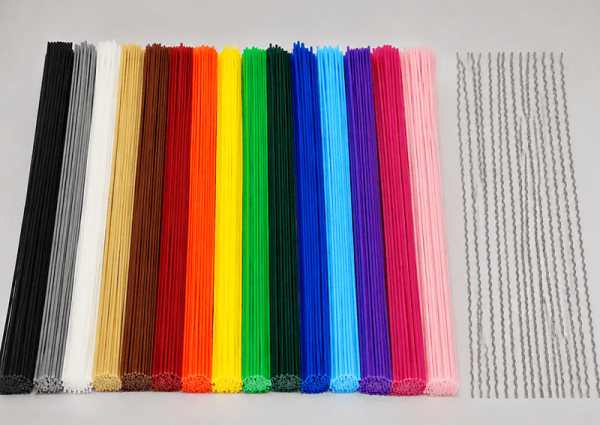
We can produce wafer brushes in three materials: PP plastic filament, corrugated steel wire, and a mixture of both.
We can produce 100% virgin PP or, for cost-effectiveness, a mixture of recycled PP and virgin PP as per customer requirements.
We commonly use 0.65mm (0.026”) diameter, but 0.70mm (0.028”) diameter can also be used upon request.
It varies depending on customer needs and the local environment. For example, our customers from South Korea, the United States, and Canada most often purchase wafer brushes with PP plastic filament for snow removal, dirt and gravel in road construction site sweeping. Customers from the Middle East and Central and South America, however, purchase not only PP plastic filament wafer brushes but also steel wire and mixed wafer brushes for high-intensity cleaning needs such as road sweeping, construction site cleaning, heavy asphalt millings or dried mud sweeping, and port and dock cleaning.
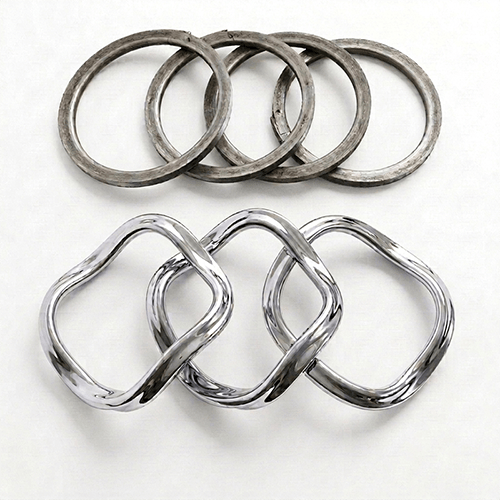
Shapes of metal ring on the Wafer Brushes
There are three shapes of wafer brushes: flat, curved/wavy/convoluted/cambered, and sloped.
Flat wafer brushes require a spacer for spacing; that is, there must be a spacer between every two flat wafer brushes.
Curved wafer brushes do not require a spacer, which saves on operating costs to some extent.
Sloped wafer brushes are typically installed on the far left and far right of the sweeper, one each. Some customers with special cleaning needs may purchase only sloped wafer brushes, such as fruit harvesters in large farms, which are equipped with large sloped wafer brushes to sweep and collect almonds, walnuts, etc.
More Questions Regarding the Wafer Brushes You May Have
The most common use of the wafer brush is to sweep up debris, gravel, small stones, and sand during road construction; to sweep up asphalt and cement debris during road repair; to sweep up coal slag, coal slime, and coal blocks at coal mine construction sites; and to sweep up large areas of snow on the road surface in cold winters.
You’ll see super-large sweepers like AB Schmidt and Boschung, equipped with wafer ring brushes, clearing snow from runways at airports at high latitudes around the world; you’ll see skid steer loaders like BOBCAT, CASE, and CAT pushing powerful sweepers loaded with wafer ring brushes to clear the road surface at road construction sites; you might also see large urban sweepers like Dulevo, Elgin, and Tennant, equipped with wafer ring brushes, clearing mud, gravel, moss, and other debris from roads at ports, large outdoor parking lots, highways, and large residential areas.
Using a 72” (1829 mm) long sweeper mandrel as an example, you would need:
1829 / (17 + 17) ≈ 54 flat wafers.
This is because the thickness of a single brush ring is 17 mm, and the thickness of a single spacer ring is also 17 mm. Each flat wafer brush requires one spacer to be installed in the sweeper.
Still using a 72” (1829 mm) long sweeper mandrel as an example, you would need:
1829 / 45 ≈ 41 curved wafers.
This is because the curvature of each curved metal ring is approximately 45 mm. Each curved wafer brush does not require an additional spacer. Therefore, using curved wafer brush is more economical than using flat wafer brush.
Let’s take the BOBCAT S650 and S570 as examples. They use 130*570 mm and 162*570 mm curved brushes. Normally, a machine needs 38 brushes. If it works for 40 minutes a day, this set of brushes can last for 40 hours, which is approximately a 2-month lifespan.